In Hinduism, various types of moksha are described. According to our religious tradition, moksha is not of just one kind; rather, it is understood in many forms. In fact, based on the different paths of spiritual practice, devotion, and knowledge, multiple forms of moksha are recognised.
How many types of Moksha are there?
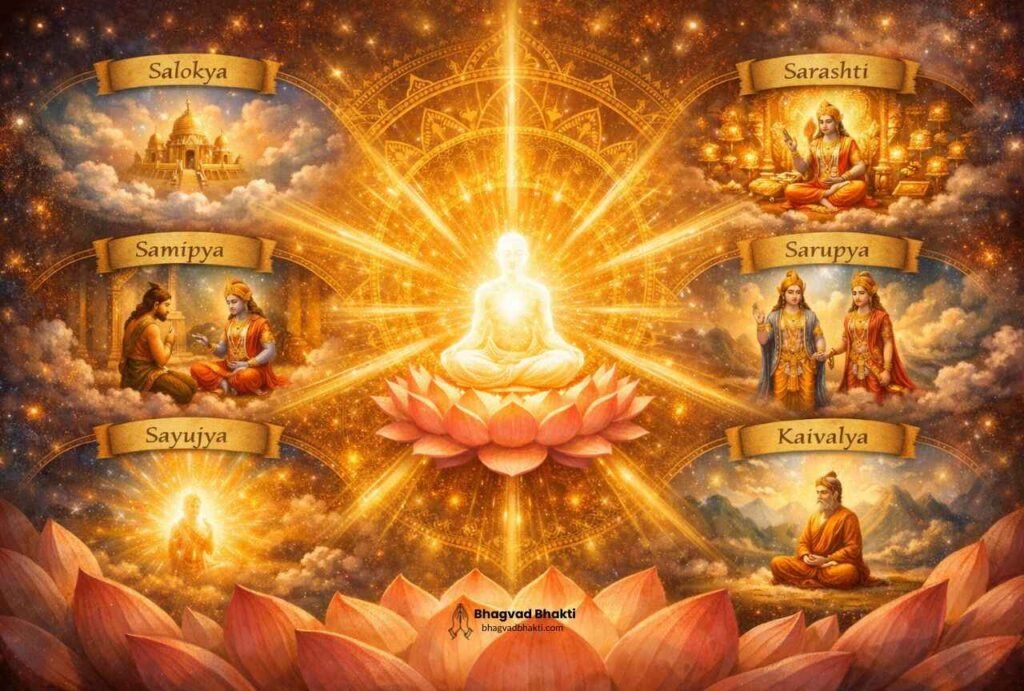
There are six types of moksha.
- Salokya Moksha
- Sarshti Moksha
- Samipya Moksha
- Sarupya Moksha
- Sayujya Moksha
- Kaivalya Moksha
Salokya Moksha
Salokya Moksha refers to the attainment of the divine abode of God. In this state, the devotee or spiritual seeker is granted residence in the realm (loka) of their chosen deity.
Sarshti Moksha
Sarshti Moksha is attained when a devotee receives divine opulence and powers equal to those of God. The devotee Dhruva, a devotee of Lord Vishnu, was blessed with Sarshti Moksha.
Dhruva had asked the Lord for royal prosperity. As a result, while he lived on Earth, he ruled as a sovereign (chakravarti) king. After his death, he attained Dhruva Loka, where he continues to reign as a king.
Samipya Moksha
Samipya Moksha is the state in which a devotee attains closeness to God in the divine realm. In this form of moksha, the devotee is blessed with the opportunity to remain near the Lord.
Closeness here means that the devotee receives daily divine darshan of God or is granted the privilege of serving Him in some form.
Sarupya Moksha
Sarupya Moksha is the attainment of a form similar to that of God. In this state, the devotee is blessed with a four-armed (chaturbhuja) divine form like that of the Lord.
Divine attendants such as Jaya and Vijaya reside near the Lord, serving Him while possessing the same four-armed form. Likewise, Gokarna, who liberated Dhundhakari from the state of a restless spirit, is said to have gone to the divine abode in a bodily form resembling the four-armed form of Lord Vishnu.
Sayujya Moksha
Sayujya Moksha is also known as the moksha of oneness. It is the state in which the devotee becomes completely united with God, merging into Him entirely.
In this form of moksha, the devotee dissolves their individual identity and remains eternally absorbed in God, experiencing complete unity without any sense of separateness.
Kaivalya Moksha
Most people are unable to clearly distinguish between Kaivalya Moksha and Sayujya Moksha, but these are two distinct forms of liberation.
Kaivalya Moksha is the state in which only the true nature of the soul—its Brahman-realised essence—remains. It is not attained through devotion (bhakti), but through the realisation of the ultimate truth and spiritual knowledge (tattva-jnana).
Related Post

Why do no rituals or religious ceremonies seem to be successful nowadays?