The royal fort of Delhi… hundreds of armed soldiers… and a saint imprisoned within its walls — then suddenly, chaos erupts across the empire. According to a fascinating legend, the mysterious monkeys who saved Tulsidas descended upon the Red Fort with such force that even the mighty Mughal Emperor Akbar was left powerless. But who were these monkeys who saved Tulsidas, and why would they rise in defence of a saint? Was this a divine intervention linked to Lord Hanuman, the extraordinary power of devotion, or a symbolic tale shaped by faith and folklore? This enduring story of Goswami Tulsidas continues to captivate believers and historians alike, blurring the line between miracle and history.
When Emperor Akbar Summoned Goswami Tulsidas
This incident dates back to the time when the Mughal emperor Akbar ordered the revered saint Goswami Tulsidas to appear at the Red Fort in Delhi. At first, Tulsidas Ji humbly refused to attend the royal court. However, considering that, because of him, Akbar might cause trouble to the devotees in Kashi, he eventually set out for Delhi.
In Akbar’s mind, there was less curiosity about the saint and more desire to witness a miracle. He had received news that through Tulsidas Ji’s prayer, a dead person had come back to life. For this reason, he summoned him to the court so that he himself could witness some extraordinary miracle.
Upon reaching the court, Akbar commanded in a stern voice, “Show us a miracle.”
Tulsidas Ji replied calmly and firmly, “I am not a miracle worker, only a servant at the feet of Shri Ram.” Seeing his demand refused in front of everyone, Akbar became furious. His ego could not tolerate such a refusal, and he ordered that Tulsidas Ji be imprisoned.
Legend has it that it was in that very prison that Tulsidas Ji composed the Hanuman Chalisa. According to some beliefs, he was such a great chanter of the name of Ram that Lord Hanuman could not bear his suffering. The son of the Wind, Hanuman, himself appeared before him at night.
Lord Hanuman affectionately asked, “Tulsidas, are you well?”
Tulsidas Ji humbly replied, “Lord, by Your grace, all is well. Outside, because of fame, people surround me all the time. Here, there is solitude; I have found a wonderful opportunity to chant the name of Ram.”
Hanuman Ji smiled and said, “No, Tulsidas, this cannot continue. A miracle must be shown.”
With folded hands, Tulsidas Ji said respectfully, “Lord, for me, You Yourself are the greatest miracle. Please do whatever you think is appropriate.”
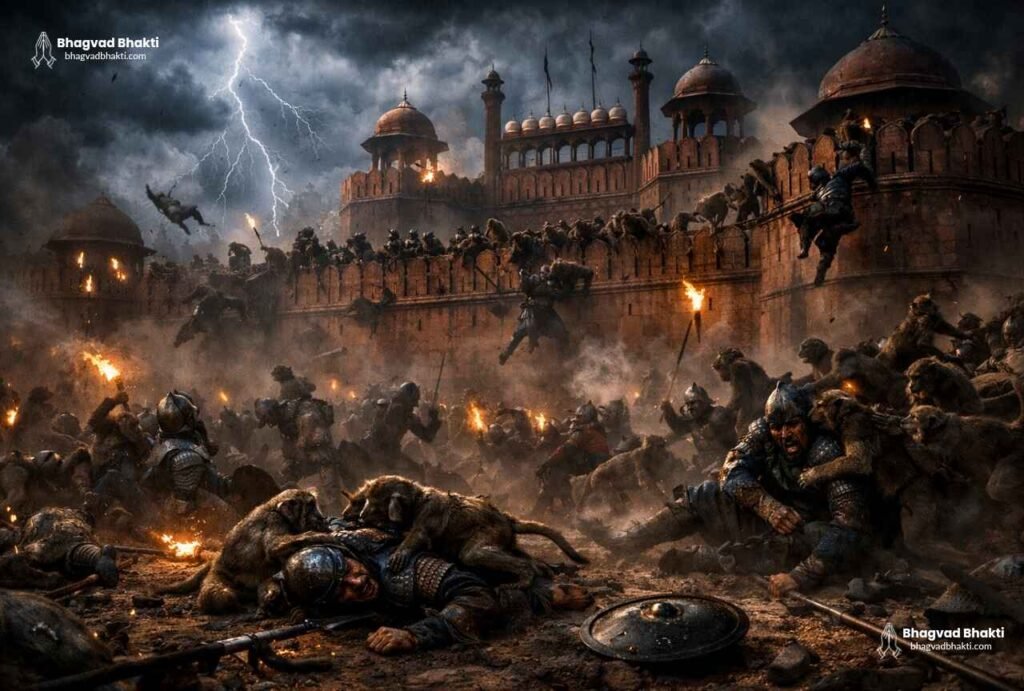
As soon as he said this, by Hanuman Ji’s grace, thousands of mighty vanaras (monkeys) appeared. Those gigantic monkeys began creating havoc throughout the fort. They lifted and threw soldiers aside, and chaos spread everywhere. No one could understand how or why all this was happening.
When the situation went completely out of control, Emperor Akbar asked his wise minister Birbal about the cause. Hinting at the reason, Birbal said, “Your Majesty, you were the one who wished to see a miracle.”
Now the emperor’s pride was shattered. Frightened and ashamed, he bowed his head and prayed, “O Tulsidas, forgive us. Please stop this miracle. From this day forward, I will never ask a saint to display a miracle.”
Tulsidas Ji silently prayed to Hanuman Ji. At that very moment, all the vanaras disappeared. The atmosphere became calm again, as if nothing had happened.
In the end, Akbar released Tulsidas Ji from prison and respectfully bid him farewell. This episode is not merely a tale of a miracle, but a symbol of a saint’s humility and the glory of devotion to God, where ego bows down and devotion triumphs.
Who were the monkeys that saved Goswami Tulsidas?
According to folk tradition, this episode is linked to the Treta Yuga. When Ravana was slain and Vibhishana was granted the kingdom of Lanka, the entire vanara army made a unique request before Lord Shri Ram.
In a playful tone, the vanaras said, “Lord, it is in our nature to create mischief. During the war, we were bound by rules and discipline, so we could not act according to our true nature. Now, please permit us to create a little commotion in Lanka.”
Seeing their childlike curiosity and enthusiasm, Lord Shri Ram permitted them. Thereafter, most of the vanaras accompanied Hanuman Ji to wreak havoc in Lanka.
However, shortly before this, several thousand vanaras had gone into the forest to gather roots, fruits, and other provisions for the entire army. By the time they returned, the other vanaras had already completed their “celebration” and come back.
Now these vanaras too were eager to receive permission to create mischief. They prayed to Lord Shri Ram, but this time the Lord smiled and refused. Hearing this, they became deeply disappointed and saddened.
Then Hanuman Ji consoled them, saying, “Do not be disappointed. All of you will remain reserved forever. In the future, whenever there is a need to protect dharma or for some special purpose that requires upheaval, you alone will be called.”
According to legend, those same mighty and gigantic vanaras of the Treta Yuga manifested again in a later age. When the Mughal emperor Akbar imprisoned Goswami Tulsidas, Hanuman Ji summoned those very “reserved” vanaras.
They created such an uproar in the Red Fort of Delhi that all the soldiers were thrown into panic. The fort fell into chaos, and in the end, the emperor had to acknowledge the greatness of the saint.
This story does not merely describe a wondrous event; it also conveys that whenever a true devotee faces danger, divine forces manifest in one form or another to protect him.


